Welcome back, Spacers!
It’s strange, the moment when a project stops being a list of tasks and starts to feel inevitable. You look around the table and realize everyone’s speaking the same quiet language of sketches, notes, data, laughter, and a hundred tiny arguments, that somehow point in one direction.
That’s where we are now. The pieces of Enormity are no longer scattered across departments, because they’re beginning to fuse. The systems hum in unison, the production line is awake, and the game feels whole.
In this update, we’ll take you into the heart of that process: how we reshaped the rulebook and combat rhythm, how production is going, and how the prototypes from the factory turned myth into matter. We’ll also share a quick note about what’s changing inside our Customer Support, because even ships like the Shepherd need a little internal tune-up.

Production Update
Production has entered its most intricate stage. Each department now works in tight synchrony, transforming designs and digital plans into tangible reality. The miniature phase stands complete, every model approved and locked for manufacturing, and you will see a selection of prototype photos from the factory later in this update. Attention has now shifted toward the systems and materials that define how Enormity will feel in players’ hands.
The rulebook has passed its final design and consistency checks. Over the past weeks, the core rules have gone through extensive testing, leading to several adjustments and refinements (some of which you will read about later in this update).
At this stage, the text is in the hands of our proofreaders and editors, who are polishing every line with great care. We are paying particular attention to the feedback many of you shared about the rulebooks from our previous projects, determined to make this one the most precise and readable version yet. Once the final layout is ready, we will make the complete rulebook available to all backers for review.
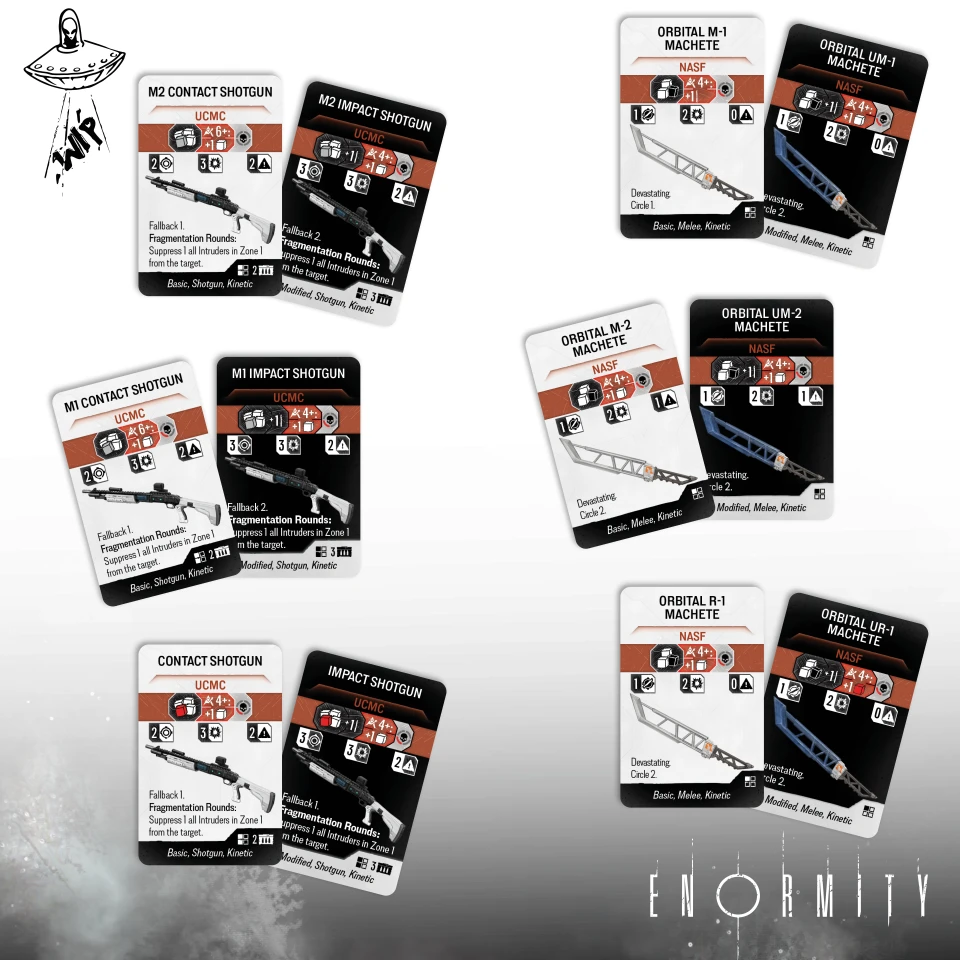
Layout teams are refining the clarity and usability of Gear and Boss cards, ensuring that every icon, ability, and keyword communicates instantly across the table. The goal is simple: no hesitation, no confusion, only flow.
Meanwhile, the QA continues one of its most precise phases yet. The team runs deep balance passes across multiple campaign branches, cross-tests systems, and measures each beat of tension and release. Every spike of danger, every pause before a decision, and every desperate roll of the dice must feel deliberate. Enormity thrives on pressure and consequence, and the QA ensures that both strike exactly where they should.

Beyond all this work, another milestone approaches. In the next update, we will finally unveil something remarkable: the white copy of Enormity.
For those unfamiliar, a white copy is the first unprinted, full-material prototype of the game. It includes every component in its final shape, size, and material, but without any color or graphics. This version allows us to test structural integrity, insert tolerances, and the overall physical balance of the box before production begins.
A white copy marks the moment when the game stops existing only as data and renderings. It gains weight, texture, and space. For the first time, the world of Enormity can be held in both hands, still blank, but very much alive.
With production on track, we can shift to the part of this update that feels like the true highlight…
The Rulebook: Good Was Never Enough
The Enormity team arrived at Marcin’s desk late in the afternoon, carrying a document and a faint smell of cold coffee. Weeks of rulebook drafts, mechanical tweaks, and design passes had led to this moment. For the first time, the complete game lay waiting on the table: full, functional, but…
“We think it is pretty good,” someone said. The room stayed quiet for a moment too long.
Marcin looked at the rulebook, then at the team. His voice was calm, almost soft, yet it carried through the whole room. “Good is not enough. It needs to be perfect.”
That moment marked the beginning of what became known inside the studio as the Extremity Phase. By then, the game’s structure was already strong. Working with nearly final components turned every adjustment into a surgical act. Even the smallest change could reshape an entire session. Mateusz described it as “operating on something that already breathes.” Everyone understood exactly what he meant.
“Extremity” became the studio’s quiet mantra: the pursuit of precision, the push beyond good.

The Pulse Test
The team gathered in Marcin’s room to find the pulse of Enormity. On the table: one of the Dark Side of the Sun’s scenarios. Tight corridors and vertical spaces are perfect for stress-testing every system.
Przemek and Dawid from design, joined by Kacper from testing, set up the board. Marcin watched from the side, silent, taking notes. They wanted to show how the systems connected: stealth, movement, blips, combat, and escalation.
The first run unfolded in silence. The team moved carefully, avoided noise, and slipped through the map unseen. It was clean, efficient, and even elegant. The second run began louder, with alarms triggered, and waves of intruders flooded the deck.
Both runs worked. The rules held, the systems responded, and the mission ended as planned. Yet, when it was over, everyone knew something still felt off. The stealth run felt safe for too long, the loud run turned predictable too fast. The tension, the heartbeat of Enormity, faded in between.
Marcin pointed to the board. “If you want stealth, that’s fine. But enemies must stay unpredictable. Sooner or later, open combat must happen. Extraction should always happen under pressure, never in calm.” So it was more about rhythm than just difficulty or balance. The decision to revisit core systems came that same day. From that session onward, Extremity stopped being a concept and became practice.

Where the Threat Begins
Once the decision was made, the first thing to go under the knife was pacing.
Blips became the focus. They had always represented something in the dark, unseen, waiting. But they moved too predictably, too politely. The new design made them faster, sharper, and more determined. They now spawn closer to Priority Targets and pursue more intelligently, closing distance instead of circling it.
Scouting them became riskier. The base Scout AT rose from 1 to 2, making discovery harder and more uncertain. The action no longer grants an immediate attack. It allows you to reposition a Blip instead. You can buy a moment of time, but safety never comes cheap. (Numerical values may still change as we finish the final balance passes, so do not hold too tightly to specific numbers)
Then came a new addition: the Ambush Blip. When revealed, it strikes immediately, even if the Scout test succeeds. The first time it appeared during testing, the whole table froze. What had been routine suddenly felt dangerous again. That small unpredictability shifted the entire tone of exploration. The map started to feel alive once more, whispering threats before showing them, watching from the dark as players took one step too far.

The Ship Awakens
As the new systems took shape, the environment had to evolve with them. The board could no longer serve as a static backdrop. Every surface, every corridor, needed intent.
Each Extraction Run now begins with pressure. Two Intruders wait from the very start, their presence turning the first movement into confrontation. New areas conceal more of them, hidden in dark corners and behind sealed doors. The Shepherd watches. Its decks are never still.
Intruder Breach Points now punctuate the maps: marked zones through which the enemies can enter mid-mission. They keep the tension alive, ensuring that no path stays safe for long. Even an empty room carries risk. Unexplored room tokens (working name) now mark unknown locations, each one a small coin toss between relief and disaster. A token might reveal a discovery, nothing at all, or a waiting Intruder ready to strike the moment you cross the threshold.
The map breathes differently now. Every corridor feels aware of your presence, every open door another decision measured in heartbeats.
To keep pace with the increased pressure, movement itself had to become smoother. Interacting with Consoles or Engrams no longer interrupts your turn. You can burst into a room, collect data, and move on, if the ship lets you. Movement ranges were slightly extended, and new actions like Jump let Spacers cross obstacles and reposition with greater freedom.
Extraction changed too. Once the point is unlocked, it can be triggered instantly. There are no more delays, no scripted countdowns. If you find a way out, you take it, though the ship rarely lets you leave without a fight.

The Clock That Watches
Every system needs rhythm, and in Enormity that rhythm comes from time itself. The Countdown track sets the pressure that grows across each mission. Earlier versions gave players too much space and too many quiet moments between threats. The new structure is shorter, replacing the ten steps with only seven: two white, two red, two black, and the final Zero Hour.
The total duration remains similar, but the feeling is different. As the track advances, the world reacts. Enemies move with greater intent, systems accelerate, and Extraction becomes a race against the inevitable.
The mission now rewards quick, deliberate play. Every hesitation costs ground, and ground is time. Zero Hour always waits, and it’s closer than it seems.
The Second Strike

With pacing and movement redefined, combat followed. Our tests with Marcin revealed that the flow of firefights still felt too restrained. Every exchange mattered, but the rhythm of battle lacked momentum. The solution came from the cards.
The Action Deck has been rebuilt to create a faster, more deliberate tempo. Each Spacer can now strike twice during a single turn: a full attack and a lighter one. The second one may not kill, but it suppresses enemies, controls the field, and buys precious seconds before the next wave arrives. Combat now breathes in bursts: attack, adjust, adapt.
Extra actions increase adrenaline, pushing players toward faster, riskier turns. To keep the flow steady, Spacer tokens are now resolved at the end of each round rather than mid-turn. This change keeps the rhythm intact and removes unnecessary breaks in the middle of the action.
Core skills (Analyze, Rearm, Rationalize, and Scout) were moved onto their own set of double-sided cards. Each includes movement on the reverse side, expanding tactical options without adding complexity. Every hand now feels flexible, every turn alive with possibility.
The result is subtle but profound. Encounters now unfold as controlled chaos. Every decision pushes the next one forward, and every moment of calm feels temporary.

The Sound That Hunts You
Combat introduced speed. The next challenge was to let the world react in kind. The Alert System became the spine of that reaction, a quiet layer of tension running beneath every action.
Every twelve Alert tokens trigger a chain reaction: a Blip appears, the nearest Intruder activates, and another enemy joins the field. The system acts on its own rhythm, measuring player noise and responding with precision.
During testing, the first time this event occurred mid-turn, the entire table fell silent. It changed how people played. Players stopped tracking numbers and began to sense pressure instead – that slow, unspoken countdown in the back of the mind.

Every move now feeds the system. Firing too often, running too far, and even scanning the environment increases Alert. Scanner cards create faint pulses that carry through the decks, a reminder that every signal leaves a trace. Alert overflow no longer resets. It stays in play, pushing the next danger closer. Each point becomes part of a hum that never fades completely.
The mechanic keeps the tension alive. The board listens, holds its breath, and waits for one sound too many.

The Calm Before Impact
The Countdown track, first mentioned earlier in this update, presents its full weight during Boss Incursions. Time becomes part of the fight itself, setting the pace and defining how long control can last.
Bosses now act before the players at the start of each round. This change reshapes the rhythm of combat and forces constant adaptation. Every phase opens with a strike, keeping players reactive and alert.
As the Countdown advances, the battlefield grows unstable. Each step narrows the space for decisions, and reaching Zero Hour during combat transforms the encounter in unpredictable ways.
The new Alert System also feeds directly into these fights. Again, twelve tokens trigger a Boss reaction: an attack, a shift, or an escalation. The sound and movement generated throughout the mission become part of the fight, turning pressure into consequence.
Boss encounters now mirror the core of Enormity itself: continuous tension, limited control, and the sense that every second counts.

Controlled Chaos
Work on Extremity brought every system together. Blips dictate movement. Movement builds Alert. Alert fuels response. Countdown shapes the pressure that holds everything in place. Each run feeds the next until the board begins to feel alive again. The tension no longer rises in bursts but moves like a slow current under every action. Players learn to read the rhythm of the board and to hear it, not just play it.
Moments of silence at the table changed too. They feel measured, temporary, like the calm before the storm. Conversations grow quieter. Plans become shorter. The game watches and waits.
Extremity was never about rewriting Enormity. It was about finding its pulse and letting it carry through every decision, every roll, every second on the board.
Good was never the goal.
Minis, minis, minis!
Every miniature begins as a digital sculpt, polished until it meets both artistic vision and engineering precision. Once ready, these files travel to the factory for verification, where production specialists adapt them for tooling, the process that prepares each model for physical casting. Adjusted versions return to us for inspection, where we review every contour and joint, approve necessary refinements, and send them back for the next phase.
From those approved files, the factory creates the physical prototypes used to test the molds, materials, and every fine detail of the sculpt. And that is where we are now. The prototypes have arrived, and they look every bit as sharp and unsettling as we imagined. Below, you can see a selection of them, captured in their pure, unpainted form, just as they emerged from the factory.
Goliath

Pure strength given shape, a creature of impossible symmetry, The Goliath is physical perfection made of flesh and alloy, and it won’t let you forget it. To survive an encounter, you must prove your worth; only strength recognized by strength earns mercy.
Faun

All Davids demand reverence, but Faun turns worship into art. It delights in watching you debase yourself, finding beauty in your humiliation. There’s no dignity in the dance it commands, only submission. And yet, you’ll dance because it wills it.
Smiley

A grotesque parody of affection, dressed in human skin and sincerity. Its plasteel armor is impenetrable to bullets, blades, or plasma, and its approach is silent, deliberate, and almost tender. The last thing you’ll ever see is its warm, impossible smile in the dark.
Automa

Once a helpful tool aboard the Shepherd, the Automa handled cargo, repairs, hydroponic maintenance, and, when required, security. When things fell apart, the Preacher found a new purpose for their remains.
The Automa Security Unit stands rebuilt, its reinforced armor pitted with age, its infrared sensors still functional, its crowd-control shotgun eager to serve a new master. Once it pacified the discontent; now it cuts down anyone who stands in the Preacher’s way.
Worm

The Hollowed are what’s left when the Dark eats away the soul. They are husks, empty echoes of people who once had purpose. Among the most dangerous is the Worm: a mangled, crawling horror that drags itself across the decks, clutching at ankles, halting movement, and devouring hope.
Mimic

Not the strongest nor the fastest, but easily the most terrifying. The Mimic can become anyone: a survivor, a friend, even the one reading this update. Its transformations are so quick and so fluid that even awareness doesn’t protect you. Paranoia becomes part of survival. You look at your team at the table and wonder, which of them isn’t what they seem? It’s an intelligent agent of chaos, an apex predator of uncertainty.
More photos are on the way. We will show additional pics across the upcoming updates!
…and somewhere in the background, something else is stirring. Piotrek, our miniature artist and painting virtuoso (you might know him on Discord as ITU_Offek, always ready with advice and color theory), has started painting the Enormity mini prototypes. We cannot say yet why we need them painted now, but he agreed to share an early work-in-progress photo of The Conductor, and the results already look haunting. More will come soon... but for now, we will let the silence do the talking.

Customer Support Update
Behind the scenes, a small storm has been brewing. Over the past weeks, we’ve been taking a close look at how our Customer Support team operates and how we can make your experience smoother, faster, and more personal.
Marcin decided to jump straight into Customer Support, sleeves rolled up, helping the team clear the backlog and hunt down recurring issues. A few of you have already discovered that firsthand – yes, some of those emails really did come from him.
The goal is simple: to give every player, backer, and curious soul the kind of response we’d want to get ourselves. That means clearer communication, quicker turnaround, and more direct contact when it matters most.
We’re also much more active on our Discord server, chatting, answering questions, and keeping you in the loop as things move forward. If you ever wonder what’s cooking behind the curtain, that’s usually where to find out first.
Things are settling into shape, the backlog is shrinking fast, and we’re confident that from now on, everything will run smoother. Thanks for your patience and for being the kind of community that makes us want to do better.
Closing Transmission
The next update will arrive a little earlier than planned, on December 18th, one week ahead of schedule, to avoid clashing with the holidays and to give everyone a quieter end of the year. As promised, it will also carry the white copy of Enormity.
As that moment approaches, a small reminder, especially for those new to Into the Unknown projects. At the start of each new year, our games receive a price adjustment. The shift reflects production scope, material and logistics costs, and the expanding ambition of our worlds. Broader conditions also matter: global inflation, rising supplier prices, currency volatility, and ongoing geopolitical uncertainty, including the current instability in the United States, all push costs upward. Our titles will never be priced lower than they are now. You can review and secure your copy of Enormity on our pledge manager, Gameflight, HERE. If you plan to do that, this is the perfect time. More information about the upcoming adjustment will appear in the next updates.
Thank you, Spacers, for staying with us through every phase of this journey.